

How to Read a Watch Specification Sheet?

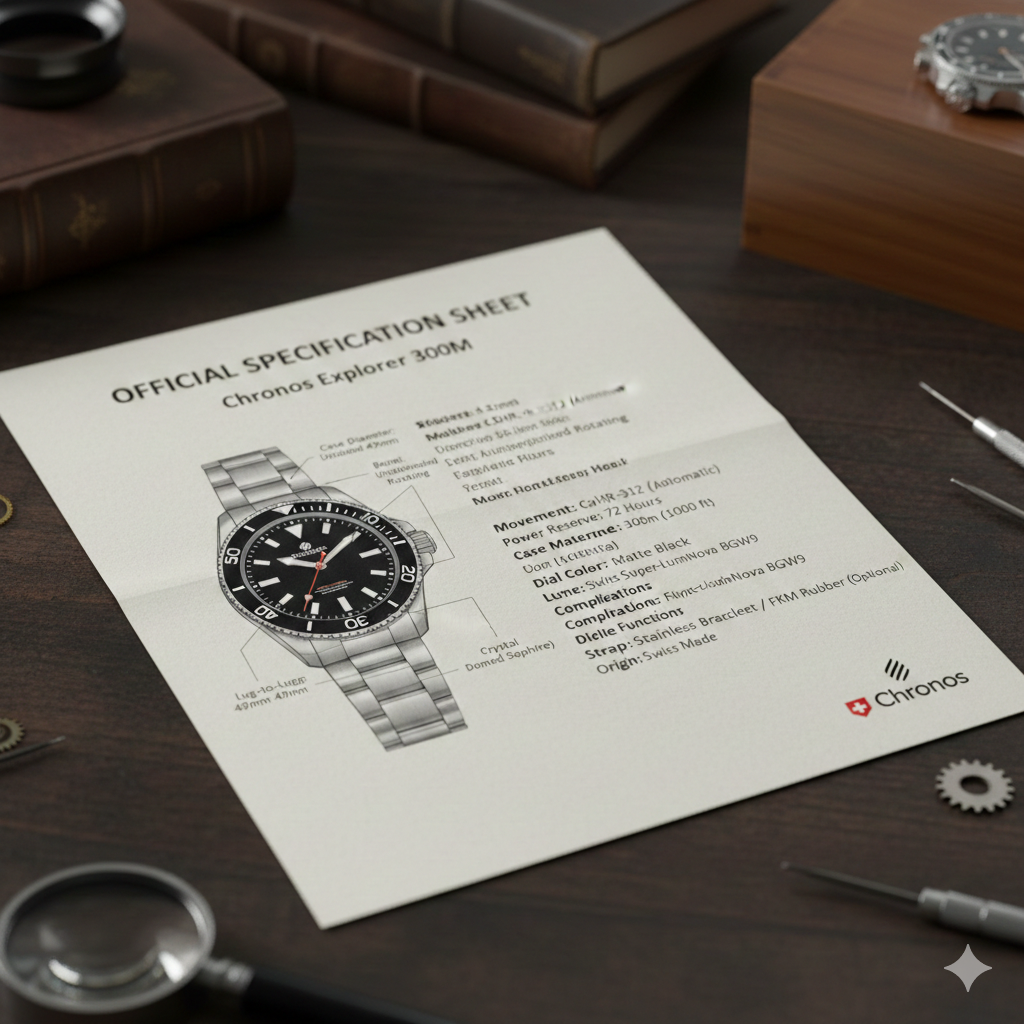
How to Read a Watch Specification Sheet21/22
A Complete, In-Depth Guide for Buyers and Enthusiasts
A watch specification sheet is more than a list of numbers — it’s a technical blueprint that explains how a timepiece is built, how it performs, and how it will feel on your wrist. Learning to read a spec sheet properly allows you to compare watches confidently, understand value differences, and avoid costly mistakes.
This comprehensive guide explains every major element you’ll encounter on a watch specification sheet, from movements and materials to tolerances and design details.
1. Movement Type (The Engine of the Watch)
The movement determines how the watch functions and directly impacts accuracy, maintenance, price, and long-term ownership.
Automatic (Self-Winding)
Automatic watches generate power through wrist motion. A rotor inside the case spins and winds the mainspring.
Key traits:
Mechanical craftsmanship
No battery
Smooth sweeping seconds hand
Requires regular wear or a winder
Needs periodic servicing
Best for enthusiasts who appreciate traditional watchmaking.
Manual (Hand-Wound)
Manual movements are mechanical but require winding by hand.
Key traits:
Slim profile
Pure mechanical interaction
Traditional appeal
Requires daily or periodic winding
Often found in vintage-style or high-end watches.
Quartz
Quartz movements use a battery and an electronic oscillator regulated by a quartz crystal.
Key traits:
Extremely accurate
Low maintenance
Lightweight
Affordable
Battery replacement required every 1–3 years
Ideal for everyday reliability and convenience.
2. Caliber (Movement Reference)
The caliber identifies the exact movement model used.
Examples:
ETA 2824-2
Sellita SW200
Miyota 8215
Seiko NH35
Brand in-house calibers
Why caliber matters:
Determines reliability and serviceability
Indicates engineering quality
Helps verify authenticity
Impacts price and longevity
Movements with widespread parts availability are easier and cheaper to service long-term.
3. Frequency (Vibrations per Hour – vph)
This describes how fast the balance wheel oscillates.
Common frequencies:
21,600 vph (6 beats/sec)
28,800 vph (8 beats/sec)
36,000 vph (high-beat)
Higher frequency = smoother seconds hand and potentially better accuracy, but also more wear.
4. Accuracy Tolerance
Some specs list expected time deviation.
Examples:
Quartz: ±10–20 seconds per month
Mechanical: ±5 to ±30 seconds per day
Chronometer-certified: −4 to +6 seconds/day
Accuracy is affected by temperature, position, wear, and maintenance.
5. Power Reserve
Power reserve indicates how long a mechanical watch runs when fully wound.
Typical ranges:
38–42 hours (standard)
50–72 hours (extended)
80+ hours (modern long-reserve movements)
Longer power reserves allow you to remove the watch for several days without resetting.
6. Case Diameter
Measured in millimeters across the case (excluding crown).
Typical sizing:
34–36 mm → classic / vintage
38–40 mm → versatile modern
41–43 mm → sporty
44 mm+ → oversized
Size choice depends on wrist size and personal preference.
7. Case Thickness
Thickness affects comfort and wearability.
Typical ranges:
8–10 mm → slim
11–13 mm → standard
14+ mm → sport or complication-heavy
Slim watches fit better under cuffs; thicker ones feel more rugged.
8. Lug-to-Lug Length
This measurement determines how the watch spans across your wrist.
Why it matters:
A large lug-to-lug can overhang small wrists
More important than diameter for fit
Typical range:
44–50 mm
9. Case Material
Common materials:
Stainless Steel
Durable
Corrosion-resistant
Most versatile
Titanium
Lightweight
Strong
Hypoallergenic
Ceramic
Scratch-resistant
Modern appearance
Lightweight
Gold (solid or plated)
Premium look
Softer metal
Higher cost
Material affects durability, weight, and feel.
10. Crystal Type
Protects the dial.
Types:
Sapphire Crystal
Highly scratch-resistant
Most premium option
Mineral Glass
Durable and affordable
Moderate scratch resistance
Acrylic
Lightweight
Vintage appeal
Easily polished
11. Anti-Reflective Coating
Some crystals have AR coating to reduce glare.
Single-sided or double-sided
Improves readability
Can wear over time if external
12. Water Resistance Ratings
Water resistance is measured in meters or ATM.
Rating | Practical Use |
|---|---|
30 m | Splashes only |
50 m | Light water exposure |
100 m | Swimming |
200 m | Diving |
300 m+ | Professional diving |
Water resistance decreases over time due to seal aging.
13. Crown Type
The crown controls setting and winding.
Types:
Push-pull
Screw-down (improves water resistance)
Some crowns are signed with the brand logo.
14. Bezel Type
Bezel functions vary by watch style.
Types include:
Fixed
Unidirectional (diver)
Bidirectional
Tachymeter
GMT
Each serves a functional or aesthetic role.
15. Dial Construction
Key elements:
Applied or printed indices
Numerals
Hands
Sub-dials
Date window
High-quality dials show sharp printing, symmetry, and clean finishing.
16. Lume (Luminescence)
Lume improves visibility in low light.
Common types:
Super-LumiNova
Tritium (older watches)
Brightness and longevity vary by application.
17. Bracelet or Strap Details
Bracelet:
Solid or hollow links
Fold-over or butterfly clasp
Micro-adjustments
Strap:
Leather
Rubber
Fabric/NATO
Comfort, durability, and adjustability matter.
18. Lug Width
Distance between lugs where strap fits.
Common sizes:
18 mm
20 mm
22 mm
Important for replacement straps.
19. Weight
Heavier watches feel more substantial; lighter watches offer comfort.
Weight depends on:
Case material
Bracelet
Size
20. Reference Number
Unique identifier for the exact model.
Used for:
Authenticity checks
Research
Warranty
Resale
21. Country of Assembly / Origin
May state:
Swiss Made
Japan
Made in Japan
These indicate compliance with specific manufacturing standards.
22. Warranty Coverage
Spec sheets often mention warranty terms.
May include:
Manufacturer warranty
Store-backed warranty
Length of coverage
Always review warranty conditions carefully.
Final Thoughts
Understanding a watch specification sheet empowers you to evaluate quality, compare models accurately, and buy with confidence. It transforms numbers into meaningful insights — helping you choose a watch that fits your lifestyle, taste, and expectations.
At Watchstreet, every listing is carefully curated and transparently presented so you can focus on what matters most: choosing a timepiece you’ll enjoy for years to come.