

Common Terms Every Buyer Should Know

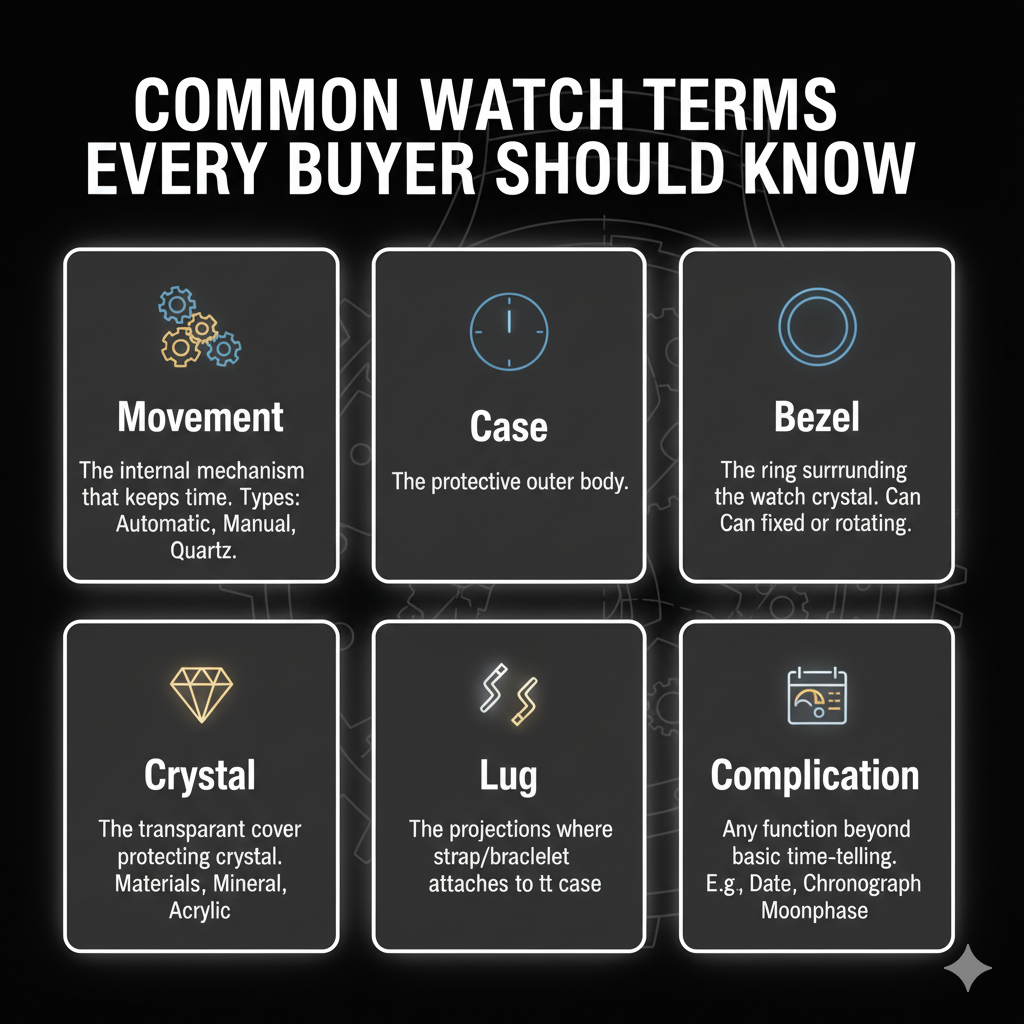
Common Watch Terms Every Buyer Should Know9/22
Buying a watch—especially a quality or luxury timepiece—can feel overwhelming if you’re unfamiliar with watch terminology. Understanding the basic terms not only helps you compare models more confidently but also protects you from confusion when browsing specifications or speaking with sellers.
This guide breaks down the most important watch terms in clear, simple language so you can make informed decisions and better appreciate what goes into a well-made timepiece.
1. Movement
The movement is the internal mechanism that powers the watch and keeps time. It’s often described as the “engine” of the watch.
Main types of movements:
▸ Automatic
An automatic watch winds itself through the natural movement of your wrist. Inside, a rotor spins as you move, storing energy in the mainspring.
No battery required
Smooth sweeping seconds hand
Appreciated for craftsmanship
Requires occasional servicing
▸ Manual (Hand-Wound)
A manual movement must be wound by turning the crown.
Traditional and mechanical
Often found in vintage or enthusiast watches
Offers a more hands-on experience
▸ Quartz
Quartz watches are powered by a battery and regulated by a quartz crystal.
Extremely accurate
Low maintenance
Lightweight and reliable
Ideal for everyday wear
2. Case
The case houses and protects the movement and internal components.
Common materials include stainless steel, titanium, ceramic, and precious metals.
Key case measurements:
Case diameter – Width of the watch (usually 36–44 mm)
Case thickness – Height of the watch
Case back – The rear cover, which can be solid or transparent
An exhibition case back allows you to view the movement inside.
3. Dial
The dial is the visible face of the watch and plays a major role in readability and design.
Dial elements typically include:
Hour markers or numerals
Hands (hour, minute, seconds)
Brand logo
Date window
Sub-dials for complications
High-quality dials feature precise printing, symmetry, and strong contrast for legibility.
4. Crystal
The crystal protects the dial from dust and damage.
Common crystal types:
Sapphire crystal
Highly scratch-resistant and used in most modern luxury watches.
Mineral glass
More affordable, decent durability, but scratches more easily.
Acrylic
Lightweight and flexible, often found in vintage-style watches.
5. Bezel
The bezel is the ring surrounding the crystal. It may be decorative or functional.
Common bezel types:
Fixed bezel – purely aesthetic
Rotating bezel – used for timing (especially on dive watches)
Tachymeter bezel – measures speed based on time traveled
Some bezels rotate in one direction only for safety purposes.
6. Water Resistance
Water resistance indicates how well a watch withstands exposure to moisture.
Common ratings:
30m / 3 ATM – Splash resistant only
50m / 5 ATM – Suitable for light water exposure
100m / 10 ATM – Safe for swimming
200m+ – Designed for diving
Always follow the manufacturer’s guidelines, as water resistance can decrease over time.
7. Complication
A complication refers to any function beyond showing hours, minutes, and seconds.
Popular complications include:
Date and day displays
Chronograph
GMT (second time zone)
Moonphase
Power reserve indicator
More complications typically mean increased mechanical complexity and craftsmanship.
8. Chronograph
A chronograph is a watch with a built-in stopwatch.
Features include:
Pushers on the case
Sub-dials measuring elapsed seconds, minutes, or hours
Central chronograph seconds hand
Chronographs are functional tools and popular design elements.
9. Power Reserve
The power reserve shows how long a mechanical watch will continue running once fully wound.
Typical ranges:
38–48 hours (standard)
60–80+ hours in modern extended-reserve movements
Some watches display this information directly on the dial.
10. Lug Width
Lug width is the distance between the two lugs where the strap or bracelet attaches.
Measured in millimeters
Common sizes: 18mm, 20mm, 22mm
Important when replacing straps
Correct lug width ensures a secure and balanced fit.
11. Crown
The crown is the small knob used to adjust time, date, and sometimes wind the watch.
Types include:
Push-pull crown – common on dress watches
Screw-down crown – improves water resistance
Many crowns feature engraved or embossed brand logos.
12. Accuracy: Automatic vs Quartz
Quartz watches are extremely accurate, typically varying only ±15 seconds per month
Automatic watches may vary by several seconds per day
Accuracy does not define quality — it reflects different philosophies:
Quartz prioritizes precision and convenience
Mechanical watches emphasize craftsmanship and tradition
13. Case Materials
The material affects durability, weight, and appearance.
Common options include:
Stainless steel – durable and versatile
Titanium – lightweight and corrosion-resistant
Ceramic – scratch-resistant and modern
Gold – luxurious and traditional
Each material serves a different purpose and aesthetic.
14. Strap vs Bracelet
Strap:
Leather
Rubber
Fabric / NATO
More flexible and lightweight.
Bracelet:
Usually stainless steel
More durable and heavier
Often gives a more formal or premium feel
15. Reference Number
The reference number identifies the exact model, configuration, and variation of a watch.
It helps with:
Authenticity verification
Finding specifications
Matching parts or straps
Researching market value
Final Thoughts
Understanding basic watch terminology helps you shop with confidence and appreciation. Whether you’re buying your first watch or building a collection, knowing these terms allows you to compare models properly and understand what you’re paying for.
At Watchstreet, every timepiece is carefully curated and verified so you can focus on choosing the watch that fits your style and lifestyle — with clarity and confidence.