
Parallel Import Watches: Everything You Need to Know
Introduction: What Are Parallel Import Watches?
Parallel import watches, also known as gray market watches, are genuine luxury timepieces sourced outside the brand’s official distribution channels. These watches are fully authentic but may differ in warranty coverage or packaging compared to authorized retailers.
Buying parallel import watches allows collectors and enthusiasts to access exclusive models, competitive pricing, and unique selections, often not available through official channels.
1. Are Parallel Import Watches Authentic?
Yes. Parallel import watches are 100% genuine. The key difference is how they are sourced:
-
Official retailers purchase directly from the brand.
-
Parallel importers buy from authorized distributors or global partners.
2. Warranty Considerations
One common concern is warranty coverage. Parallel import watches may not carry the manufacturer’s global warranty, but reputable sellers often provide store-backed warranties, giving you protection similar to official channels.
Tip: Always check the warranty policy before purchasing a gray market watch.
3. Why Choose Parallel Import Watches?
-
Competitive Pricing: Lower prices compared to official channels
-
Exclusive Availability: Access to rare or limited editions
-
Verified Authenticity: Professional inspection ensures genuine products
-
Curated Selection: Focused drops and premium timepieces
Parallel imports allow collectors to enjoy luxury watches with smart value and confidence.
4. How to Identify a Trusted Parallel Import Seller
When buying a parallel import watch, look for:
-
Authentication processes (pre-listing verified or expert-checked)
-
Clear warranty information (store-backed or limited)
-
Transparent sourcing (globally sourced, not counterfeit)
-
Positive customer reviews
5. Caring for Your Parallel Import Watch
Parallel import watches are identical to officially retailed pieces, so proper care is the same:
-
Regular servicing
-
Safe storage in original boxes or winders
-
Avoiding extreme conditions
-
Cleaning carefully with soft cloths
Proper care preserves both functionality and value.
Conclusion
Parallel import watches are an excellent way to access authentic luxury timepieces at competitive prices. When sourced from trusted, verified sellers, they provide all the prestige and quality of official watches — often with added value.
Should You Buy Parallel Import or Authorized Dealer?
When buying a luxury watch, one important decision often comes up: should you buy from an authorized dealer or choose a parallel import (also known as grey market)?
Both options are legitimate, and each has clear advantages depending on your priorities — price, warranty, availability, and long-term value. This guide explains the differences clearly so you can decide with confidence.
What Is an Authorized Dealer?
An authorized dealer (AD) is officially approved by the brand to sell its watches. These retailers work directly with the manufacturer and must follow strict brand guidelines.
Key Features of Authorized Dealers:
-
Official partnership with the brand
-
Watches sourced directly from the manufacturer
-
Comes with a manufacturer warranty
-
Brand-certified packaging and documentation
-
Higher retail pricing
-
Limited discounts
-
Access to official servicing networks
Buying from an authorized dealer offers peace of mind and a fully brand-backed experience.
What Is a Parallel Import (Grey Market)?
A parallel import watch is 100% genuine and original, but it is sold through independent retailers rather than the brand’s official dealer network.
These watches are typically sourced from:
-
Authorized dealers in other countries
-
Excess or overstock inventory
-
Distributors and wholesalers
-
Closed boutiques or liquidated stock
Because they bypass official distribution channels, they are usually offered at significantly lower prices.
Key Features of Parallel Imports:
-
Authentic, original watches
-
Not sold directly by the brand
-
Often 30–60% more affordable
-
May include seller or third-party warranty
-
Wider availability of discontinued or rare models
-
Same physical product as AD versions
Parallel import does not mean fake — it simply means the watch was imported outside the brand’s official retail network.
Side-by-Side Comparison
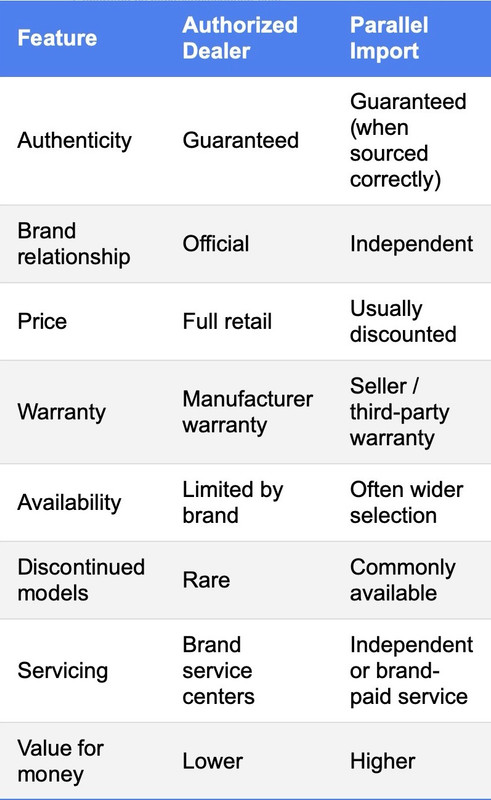
Warranty: The Biggest Difference Explained
Authorized Dealer Warranty
-
Issued directly by the brand
-
Typically 2–5 years
-
Accepted worldwide
-
Service handled by brand service centers
Parallel Import Warranty
-
Usually provided by the seller
-
May be in-house or third-party
-
Covers movement and manufacturing defects
-
Repair handled through approved watchmakers
In real-world use, many mechanical repairs are identical regardless of warranty source — the difference lies in who pays and where the service is done.
Are Parallel Import Watches Safe to Buy?
Yes — when purchased from a reputable seller.
The risks come not from the concept of parallel imports, but from:
-
Unverified sellers
-
Lack of transparency
-
Poor after-sales support
-
Missing documentation
A trustworthy retailer should:
-
Guarantee authenticity
-
Provide warranty coverage
-
Clearly explain sourcing
-
Offer return or support policies
-
Verify every watch before listing
When these standards are met, parallel imports are a smart and safe way to buy luxury watches.
Why Many Buyers Choose Parallel Imports
Parallel imports have become increasingly popular for several reasons:
-
Significant savings on the same watch
-
Access to sold-out or discontinued models
-
Better value for collectors
-
More flexible pricing
-
Ideal for buyers who prioritize the watch itself over brand packaging
Many experienced collectors actually prefer parallel imports because they understand the product is identical — only the sales channel differs.
When You Should Choose an Authorized Dealer
Choose an authorized dealer if you:
-
Want official brand warranty paperwork
-
Prefer a boutique experience
-
Are buying a gift that needs full brand presentation
-
Value brand relationship and after-sales prestige
-
Are purchasing limited editions tied to AD allocation
When You Should Choose a Parallel Import
Choose a parallel import if you:
-
Want better value for money
-
Are price-conscious
-
Want discontinued or rare models
-
Care more about the watch than the retail experience
-
Prefer flexibility and wider selection
-
Are comfortable with seller-backed warranties
The Truth: Both Options Are Legitimate
There is no “wrong” choice — only what fits your priorities.
Many watch enthusiasts own both:
-
Authorized dealer purchases for special milestones
-
Parallel imports for everyday wear and value-driven buys
What matters most is authenticity, condition, and trust in the seller.
Buying with Confidence at Watchstreet
At Watchstreet, every timepiece is:
-
Carefully sourced
-
Fully authenticated
-
Individually verified
-
Transparently listed
-
Selected for quality and value
Whether you’re choosing an automatic or quartz watch, parallel import or authorized stock, our goal is simple: help you buy with confidence and clarity.
Final Thoughts
Choosing between a parallel import and an authorized dealer comes down to one question:
Do you value brand-backed experience — or maximum value for your money?
Both paths lead to owning a genuine timepiece. The best choice is the one that fits your lifestyle, budget, and expectations.
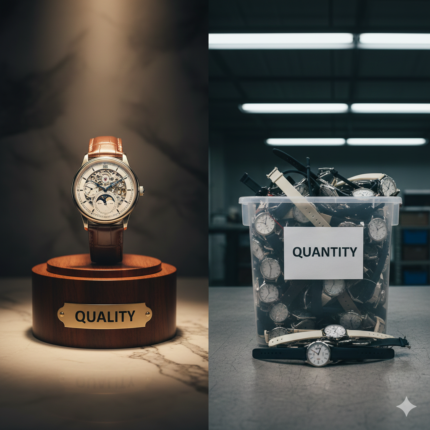
Why We Focus on Quality Over Quantity
At Watchstreet, we deliberately choose quality over volume — not because selling more is difficult, but because doing things properly matters more.
In an industry where many platforms list thousands of watches without ever handling them, we take a different approach. Every watch we offer is intentionally selected, inspected, and approved before it appears on our site. This level of care simply isn’t possible at mass scale.
Fewer Watches. Higher Standards.
We don’t aim to be the biggest marketplace. We aim to be the most dependable.
By keeping our collection focused, we’re able to apply stricter standards to every piece, including:
Authenticity verification
Condition checks
Model and reference validation
Pricing fairness review
Only watches that meet our internal criteria move forward. If a piece doesn’t meet our standards, it doesn’t get listed — regardless of demand.
Curation Protects Buyers
Volume-driven platforms often rely on automation and third-party listings, which can lead to inconsistencies and uncertainty. Our curated model reduces those risks.
Because we work with a limited number of vetted sources, we can:
Maintain consistency in quality
Reduce sourcing errors
Verify each item before listing
Stand behind every watch we sell
This is how we protect buyers — not with promises, but with process.
Better Value Through Selective Sourcing
Focusing on quality also allows us to source more intelligently. Rather than chasing every model, we select watches that offer strong value relative to their market price.
This approach enables:
Competitive pricing without shortcuts
Genuine timepieces sourced through parallel import channels
Transparent listings with realistic expectations
You get value without compromise.
A More Considered Buying Experience
Luxury should feel intentional, not overwhelming.
By limiting quantity, we make it easier to discover watches worth owning — pieces chosen for craftsmanship, design, and long-term appeal. Each listing reflects a deliberate decision, not an algorithm.
Our Commitment
Quality over quantity isn’t a slogan — it’s a system.
It shapes how we source, inspect, list, and support every watch. It’s the reason customers trust Watchstreet when buying online, and why every piece we offer is one we’re confident putting our name behind.
Because one carefully chosen watch is always better than hundreds listed without care.
Common Myths About Discounted Luxury Watches
Luxury watches are often associated with exclusivity and high price tags, so it’s natural to question how authentic timepieces can sometimes be offered at lower prices. Unfortunately, this confusion has led to many myths around discounted luxury watches.
In reality, discounted pricing does not automatically mean lower quality, inauthentic products, or hidden compromises. Below, we clarify the most common misconceptions and explain how discounted luxury watches truly work.
Myth 1: Discounted Luxury Watches Are Not Authentic
One of the biggest misconceptions is that a lower price means a watch is fake. In truth, many discounted luxury watches are completely genuine and sourced through legitimate global supply channels.
These watches are:
Manufactured by the original brand
Made with the same materials and craftsmanship
Identical in design and reference to boutique-sold models
The price difference comes from distribution, not authenticity.
Myth 2: A Lower Price Means Lower Quality
Luxury brands do not produce different quality levels for different sellers. A watch does not change in construction, movement, or finishing based on where it is sold.
Discounts usually exist because of:
Regional price differences between markets
Excess or redistributed inventory
Bulk purchasing
Currency fluctuations
Online-only operations with lower overhead
The quality remains exactly the same — only the sales channel differs.
Myth 3: Discounted Watches Are Used or Refurbished
Another common assumption is that discounted watches must be pre-owned. In reality, many discounted luxury watches are brand new and unworn.
Reputable sellers clearly distinguish between:
New watches
Pre-owned watches
Refurbished or serviced items
New discounted watches are unused and carefully inspected before being offered for sale.
Myth 4: Discounted Models Are Old, Unwanted, or Obsolete
Discounted does not mean outdated. Many watches offered below retail are current or recently released models.
Pricing differences can occur when:
New variations or updates are released
Stock needs to be rebalanced across regions
Retailers optimize inventory
Demand varies between markets
A reduced price does not diminish a watch’s design, performance, or long-term appeal.
Myth 5: There Is No Warranty or After-Sales Support
A common concern is that discounted watches come without protection. While manufacturer warranties may not always apply to parallel-import watches, trusted sellers provide their own store-backed warranty.
This ensures:
Functional coverage
Clear after-sales support
Peace of mind after purchase
What matters most is transparency about the warranty terms before buying.
Myth 6: Buying Discounted Means Taking a Risk
Buying from unknown or unverified sources can be risky — but buying from a transparent, reputable seller is not.
A trustworthy retailer will:
Clearly explain sourcing practices
Guarantee authenticity
Provide accurate product details
Offer customer support
Communicate warranty coverage upfront
When these standards are met, discounted luxury watches become a smart and informed choice.
The Reality Behind Discounted Luxury Watches
The global watch market operates across regions, distributors, and price structures. This creates opportunities for buyers to access genuine luxury watches at more competitive prices — without compromising authenticity or quality.
Discounted luxury watches are not shortcuts or compromises. They are simply an alternative path to ownership for informed buyers.
Final Thoughts
Understanding how discounted luxury watches work allows you to shop with clarity and confidence. Price alone does not define authenticity, quality, or value.
At Watchstreet, every watch is carefully curated, authenticated, and transparently presented. Our goal is to give you access to genuine timepieces at fair prices — with clarity, trust, and confidence at every step.
Are Online Luxury Watches Safe to Buy? Here’s the Truth
Buying a luxury watch online can feel risky — especially when prices look better than traditional boutiques. Many buyers ask the same question before clicking buy:
“Is this actually safe?”
The short answer: yes, when you know what to look for.
The longer answer is below — and it may change how you think about buying luxury watches online.
Why More Collectors Are Buying Watches Online
The luxury watch market has evolved. Today, many experienced collectors choose online retailers because they offer:
Better pricing
Wider selection
Faster access to global inventory
Transparent sourcing
Convenience without compromising authenticity
What matters most is not where you buy, but who you buy from.
Authenticity Is Non-Negotiable
A legitimate online watch retailer must guarantee authenticity — without exceptions.
Every genuine seller verifies their watches before listing, ensuring:
The watch is original
Components are factory-correct
Serial and reference details are valid
The condition matches the listing
This inspection step separates professional retailers from risky marketplaces.
At Watchstreet, each watch is pre-listing verified, meaning it is carefully inspected and approved before being offered for sale. This process protects buyers and maintains long-term trust.
Why Online Prices Can Be Lower (Without Cutting Corners)
Lower prices don’t automatically mean lower quality.
Many reputable online sellers operate through parallel import sourcing, which allows them to purchase watches outside official retail channels. This is legal and widely practiced worldwide.
Because of this model, online sellers can:
Avoid high boutique overhead costs
Source globally instead of regionally
Operate with leaner margins
Pass savings directly to customers
The result? Authentic watches at more accessible prices.
What About Warranty and After-Sales Support?
One of the biggest concerns buyers have is warranty coverage — and rightly so.
In many cases, manufacturer warranties may not apply to parallel-imported watches. However, professional retailers solve this by offering a store-backed warranty, ensuring protection and support after purchase.
A proper warranty should be:
Clearly stated
Time-defined
Easy to claim
Backed by a real business
This ensures peace of mind even without manufacturer registration.
Secure Payments Matter More Than You Think
Trustworthy online stores never compromise on payment security.
Look for:
Encrypted checkout pages
Trusted providers like Stripe or PayPal
No direct storage of card details
These protections safeguard your information and add an additional layer of buyer confidence.
Transparency Is the Real Sign of Trust
The safest online watch sellers are not the ones who promise perfection — but the ones who explain their process clearly.
Transparency includes:
Explaining sourcing methods
Being upfront about parallel imports
Publishing policies openly
Offering customer support
Setting realistic expectations
When a brand openly educates buyers instead of hiding details, it signals credibility.
The Bottom Line
Buying a luxury watch online can be just as safe — and often smarter — than buying in-store, when done through a transparent, professional seller.
With proper verification, clear sourcing, secure payments, and store-backed warranties, online platforms make luxury watch ownership more accessible than ever.
At Watchstreet, every piece is curated, inspected, and offered with honesty — so you can buy confidently, knowing exactly what you’re getting.
How to Identify an Authentic Luxury Watch
Introduction: Why Authenticity Matters
Luxury watches are valuable not only for their craftsmanship but also for their authenticity. With the rise of online marketplaces and global resellers, knowing how to identify a genuine watch has become essential for buyers.
Understanding the key signs of authenticity helps you shop confidently and avoid counterfeits — especially when purchasing from independent or parallel import sellers.
1. Check the Craftsmanship and Build Quality
Luxury watches are known for exceptional attention to detail. Signs of authenticity include:
Clean, precise engraving
Smooth edges and balanced proportions
High-quality materials such as stainless steel, sapphire crystal, or ceramic
Solid weight and refined finishing
Counterfeit watches often show uneven printing, rough edges, or poor alignment.
2. Examine the Dial and Logo Closely
The dial is one of the most revealing parts of a watch.
Look for:
Sharp, evenly spaced lettering
Proper logo placement
Consistent font size and spacing
Symmetry between hands and hour markers
Luxury brands maintain extremely tight quality control, so any irregularities may indicate a fake.
3. Inspect the Movement
The movement is the heart of the watch.
Quartz watches should tick consistently
Automatic or manual watches should have smooth hand movement
Exhibition casebacks often reveal detailed finishing and engraved rotors
While opening a watch yourself is not recommended, professional verification ensures the movement matches the model specifications.
4. Verify Serial Numbers and Reference Codes
Authentic luxury watches have unique serial and reference numbers engraved on the case or case back.
These numbers should:
Be cleanly engraved (not etched or printed)
Match the brand’s known formatting
Align with documentation when available
Serial numbers help confirm originality and production details.
5. Review Packaging and Documentation
Original packaging often includes:
Presentation box
Instruction manual
Warranty booklet or card
Brand tags
While packaging may vary with parallel import watches, genuine timepieces still come with proper documentation and branded materials when available.
6. Buy from Trusted and Transparent Sellers
One of the most reliable ways to ensure authenticity is to buy from sellers who:
Clearly explain their sourcing
Offer verification or inspection processes
Provide store-backed warranties
Maintain transparency about parallel imports
Conclusion
Authenticity is the foundation of any luxury watch purchase. By understanding craftsmanship, movement details, serial numbers, and seller transparency, you can confidently choose a genuine timepiece.
Whether you’re new to collecting or expanding your collection, knowledge is your strongest tool — and trusted sourcing makes all the difference.
Understanding Watch Movements: Quartz, Automatic, and Manual
Introduction: Why Watch Movements Matter
A watch movement is the engine that powers your timepiece, determining how it keeps time, its precision, and maintenance needs. Whether you’re a beginner or an experienced collector, understanding watch movements is essential for choosing a timepiece that suits your style and lifestyle.
In this guide, we’ll explore the three main types of watch movements—quartz, automatic, and manual—and their unique features.
1. Quartz Movement: Precision & Low Maintenance
Quartz watches are battery-powered and use a tiny quartz crystal to regulate time.
Key Benefits:
-
Extremely accurate timekeeping
-
Low maintenance — just battery replacement
-
Affordable and widely available
Quartz movements are perfect for people who want reliability and minimal upkeep. Many luxury brands offer quartz versions for those who prefer precision over traditional mechanical engineering.
2. Automatic Movement: Self-Winding Mechanical Excellence
Automatic watches are powered by the motion of your wrist. The movement winds itself as you wear it, storing energy in the mainspring.
Key Benefits:
-
No battery needed — powered by motion
-
Mechanical craftsmanship appreciated by collectors
-
Smooth sweeping seconds hand (distinct from quartz ticking)
Automatic movements are ideal for enthusiasts who value traditional watchmaking and mechanical engineering. They often require occasional servicing to maintain optimal performance.
3. Manual Movement: Traditional Craftsmanship
Manual watches, also called hand-wound watches, require the wearer to wind the crown regularly to power the mainspring.
Key Benefits:
-
Purely mechanical — no batteries or automatic winding
-
Often features intricate movement design visible through exhibition case backs
-
Offers a tactile and engaging experience
Manual movements are best suited for collectors who enjoy the ritual of winding their watch and appreciating mechanical artistry.
4. Choosing the Right Movement for You
When selecting a watch, consider:
-
Lifestyle: Do you want low maintenance or a hands-on experience?
-
Aesthetic preference: Do you enjoy the smooth sweep of mechanical hands?
-
Collection goals: Are you collecting for style, investment, or craftsmanship?
Understanding the difference between quartz, automatic, and manual movements empowers you to choose a watch that perfectly suits your needs. Each movement has its unique charm, functionality, and collector appeal.
Whether you prefer the precision of quartz, the engineering of automatic, or the ritual of manual winding, Watchstreet provides authentic, curated luxury watches for every type of collector.
Automatic vs Quartz: Which Should You Choose?
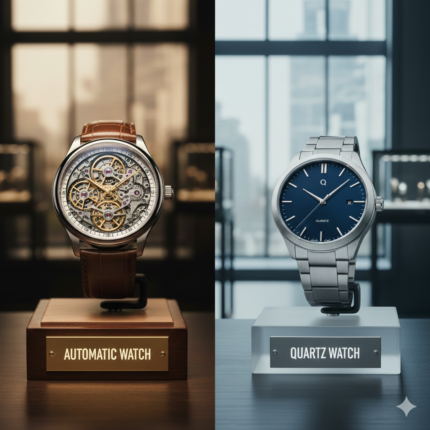
When buying a watch, one of the most important decisions you’ll face is choosing between an automatic or quartzmovement. While both serve the same purpose—telling time—they work in very different ways and appeal to different types of watch owners.
Understanding these differences will help you choose a watch that fits your lifestyle, preferences, and expectations. This guide breaks everything down clearly so you can make a confident, informed decision.
What Is an Automatic Watch?
An automatic watch (also called a self-winding watch) is powered by mechanical energy generated through the natural movement of your wrist. Inside the case, a small weighted rotor spins as you move, winding the mainspring that stores energy to power the watch.
Because of this mechanical design, automatic watches do not require batteries.
Key Features of Automatic Watches
-
Powered by wrist movement
-
No battery required
-
Mechanical craftsmanship with many moving parts
-
Smooth, sweeping seconds hand
-
Requires occasional servicing
-
Often positioned at a higher price point
Automatic watches are admired for their craftsmanship, heritage, and engineering complexity. Many collectors view them as the traditional expression of watchmaking, representing decades—or even centuries—of horological innovation.
What Is a Quartz Watch?
A quartz watch operates using a small battery that sends an electrical current through a quartz crystal. This crystal vibrates at a very precise frequency, regulating the movement of the hands with exceptional accuracy.
Quartz technology revolutionized the watch industry by making timekeeping more accurate, affordable, and accessible.
Key Features of Quartz Watches
-
Battery-powered
-
Extremely accurate timekeeping
-
Minimal maintenance required
-
Generally more affordable
-
Lightweight and dependable
-
Ideal for everyday wear
Because quartz movements are simple and efficient, they are widely used in both entry-level and luxury watches.
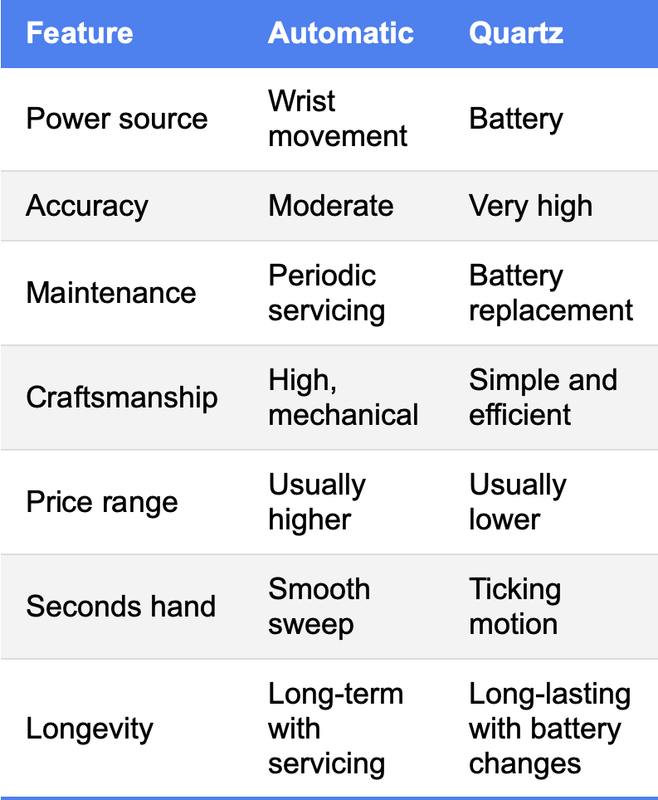
Automatic vs Quartz: Key Differences at a Glance
Which One Is Right for You?
Choosing between automatic and quartz depends on how you plan to wear your watch and what you value most.
Choose an Automatic Watch If You:
-
Appreciate traditional craftsmanship and mechanical engineering
-
Enjoy owning something with history and character
-
Wear your watch regularly
-
Value artistry and long-term collectability
-
Like the idea of a self-powered timepiece
Automatic watches offer emotional appeal, mechanical beauty, and a deeper connection to watchmaking traditions.
Choose a Quartz Watch If You:
-
Want high accuracy with minimal upkeep
-
Prefer a grab-and-go daily watch
-
Don’t want to worry about winding or power reserves
-
Want a more affordable option
-
Value reliability and convenience
Quartz watches are practical, dependable, and perfectly suited for modern lifestyles.
There Is No “Better” Choice — Only the Right One for You
Neither automatic nor quartz watches are objectively better. They serve different needs and preferences.
Many watch enthusiasts own both:
-
An automatic watch for special occasions or appreciation
-
A quartz watch for daily wear and convenience
This balance allows you to enjoy the strengths of each type.
Quality Matters More Than the Movement Type
Regardless of whether a watch is automatic or quartz, what truly matters is quality, authenticity, and proper sourcing. A well-made watch can last for years—sometimes decades—when properly cared for.
At Watchstreet, every timepiece is carefully selected and verified before being listed. This ensures that you receive a genuine, well-made watch that matches your lifestyle and expectations.
Final Thoughts
Choosing between automatic and quartz comes down to how you live, how often you wear your watch, and what you value most — tradition or convenience, craftsmanship or precision.
Whichever you choose, a thoughtfully selected watch becomes more than a tool for telling time. It becomes part of your personal style and daily rhythm.
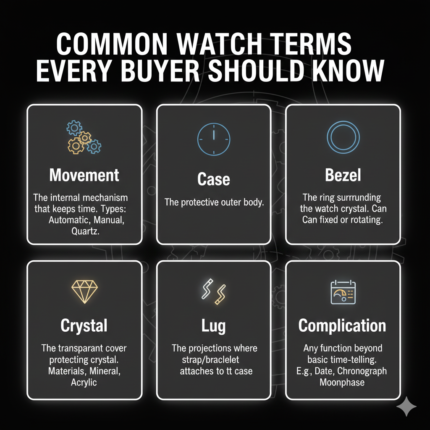
Common Watch Terms Every Buyer Should Know
Buying a watch—especially a quality or luxury timepiece—can feel overwhelming if you’re unfamiliar with watch terminology. Understanding the basic terms not only helps you compare models more confidently but also protects you from confusion when browsing specifications or speaking with sellers.
This guide breaks down the most important watch terms in clear, simple language so you can make informed decisions and better appreciate what goes into a well-made timepiece.
1. Movement
The movement is the internal mechanism that powers the watch and keeps time. It’s often described as the “engine” of the watch.
Main types of movements:
▸ Automatic
An automatic watch winds itself through the natural movement of your wrist. Inside, a rotor spins as you move, storing energy in the mainspring.
No battery required
Smooth sweeping seconds hand
Appreciated for craftsmanship
Requires occasional servicing
▸ Manual (Hand-Wound)
A manual movement must be wound by turning the crown.
Traditional and mechanical
Often found in vintage or enthusiast watches
Offers a more hands-on experience
▸ Quartz
Quartz watches are powered by a battery and regulated by a quartz crystal.
Extremely accurate
Low maintenance
Lightweight and reliable
Ideal for everyday wear
2. Case
The case houses and protects the movement and internal components.
Common materials include stainless steel, titanium, ceramic, and precious metals.
Key case measurements:
Case diameter – Width of the watch (usually 36–44 mm)
Case thickness – Height of the watch
Case back – The rear cover, which can be solid or transparent
An exhibition case back allows you to view the movement inside.
3. Dial
The dial is the visible face of the watch and plays a major role in readability and design.
Dial elements typically include:
Hour markers or numerals
Hands (hour, minute, seconds)
Brand logo
Date window
Sub-dials for complications
High-quality dials feature precise printing, symmetry, and strong contrast for legibility.
4. Crystal
The crystal protects the dial from dust and damage.
Common crystal types:
Sapphire crystal
Highly scratch-resistant and used in most modern luxury watches.
Mineral glass
More affordable, decent durability, but scratches more easily.
Acrylic
Lightweight and flexible, often found in vintage-style watches.
5. Bezel
The bezel is the ring surrounding the crystal. It may be decorative or functional.
Common bezel types:
Fixed bezel – purely aesthetic
Rotating bezel – used for timing (especially on dive watches)
Tachymeter bezel – measures speed based on time traveled
Some bezels rotate in one direction only for safety purposes.
6. Water Resistance
Water resistance indicates how well a watch withstands exposure to moisture.
Common ratings:
30m / 3 ATM – Splash resistant only
50m / 5 ATM – Suitable for light water exposure
100m / 10 ATM – Safe for swimming
200m+ – Designed for diving
Always follow the manufacturer’s guidelines, as water resistance can decrease over time.
7. Complication
A complication refers to any function beyond showing hours, minutes, and seconds.
Popular complications include:
Date and day displays
Chronograph
GMT (second time zone)
Moonphase
Power reserve indicator
More complications typically mean increased mechanical complexity and craftsmanship.
8. Chronograph
A chronograph is a watch with a built-in stopwatch.
Features include:
Pushers on the case
Sub-dials measuring elapsed seconds, minutes, or hours
Central chronograph seconds hand
Chronographs are functional tools and popular design elements.
9. Power Reserve
The power reserve shows how long a mechanical watch will continue running once fully wound.
Typical ranges:
38–48 hours (standard)
60–80+ hours in modern extended-reserve movements
Some watches display this information directly on the dial.
10. Lug Width
Lug width is the distance between the two lugs where the strap or bracelet attaches.
Measured in millimeters
Common sizes: 18mm, 20mm, 22mm
Important when replacing straps
Correct lug width ensures a secure and balanced fit.
11. Crown
The crown is the small knob used to adjust time, date, and sometimes wind the watch.
Types include:
Push-pull crown – common on dress watches
Screw-down crown – improves water resistance
Many crowns feature engraved or embossed brand logos.
12. Accuracy: Automatic vs Quartz
Quartz watches are extremely accurate, typically varying only ±15 seconds per month
Automatic watches may vary by several seconds per day
Accuracy does not define quality — it reflects different philosophies:
Quartz prioritizes precision and convenience
Mechanical watches emphasize craftsmanship and tradition
13. Case Materials
The material affects durability, weight, and appearance.
Common options include:
Stainless steel – durable and versatile
Titanium – lightweight and corrosion-resistant
Ceramic – scratch-resistant and modern
Gold – luxurious and traditional
Each material serves a different purpose and aesthetic.
14. Strap vs Bracelet
Strap:
Leather
Rubber
Fabric / NATO
More flexible and lightweight.
Bracelet:
Usually stainless steel
More durable and heavier
Often gives a more formal or premium feel
15. Reference Number
The reference number identifies the exact model, configuration, and variation of a watch.
It helps with:
Authenticity verification
Finding specifications
Matching parts or straps
Researching market value
Final Thoughts
Understanding basic watch terminology helps you shop with confidence and appreciation. Whether you’re buying your first watch or building a collection, knowing these terms allows you to compare models properly and understand what you’re paying for.
At Watchstreet, every timepiece is carefully curated and verified so you can focus on choosing the watch that fits your style and lifestyle — with clarity and confidence.
Common Watch Mistakes That Reduce Value (and How to Avoid Them)
A fine watch is more than a way to tell time — it’s craftsmanship, heritage, and in many cases, a long-term asset. Yet many watch owners unknowingly make small mistakes that slowly reduce their watch’s value, condition, and desirability.
Whether you’re buying your first quality timepiece or building a long-term collection, understanding these mistakes can help you protect both your watch and your investment.
Below are the most common watch mistakes that quietly reduce value — and how to avoid them.
1. Discarding the Original Box and Papers
One of the biggest value killers is losing the original accessories.
A complete set usually includes:
Presentation box
Warranty card or booklet
Manuals and tags
Collectors strongly prefer “full set” watches because they help verify authenticity, ownership history, and originality. The same watch can be worth noticeably more when accompanied by its original documentation.
Best practice: Always store box and papers safely, even if you never plan to sell.
2. Over-Polishing the Case
While polishing can restore shine, excessive polishing permanently removes metal and softens the sharp edges that define a watch’s original design.
Over time, this can:
Alter case proportions
Remove factory finishing
Reduce collectability
Lower resale value
Light, professional refinishing is acceptable when necessary — but frequent polishing is one of the fastest ways to devalue a watch.
3. Replacing Original Parts with Aftermarket Components
Originality plays a major role in long-term value.
Using non-original parts such as:
Aftermarket dials
Replacement hands
Generic crowns
Non-original bracelets
can significantly reduce desirability. Even small mismatches matter to collectors.
Whenever parts must be replaced, genuine manufacturer components should always be used.
4. Skipping Regular Servicing
Mechanical watches rely on hundreds of moving parts working in harmony. Without routine servicing, internal oils dry out, friction increases, and components wear prematurely.
Recommended servicing:
Mechanical watches: every 4–6 years
Quartz watches: battery replacement before leakage occurs
Neglected maintenance can lead to costly repairs and permanent damage — both of which affect value.
5. Improper Storage Conditions
How you store your watch directly impacts its longevity.
Avoid:
High humidity
Extreme temperatures
Direct sunlight
Strong magnetic fields
Poor storage can cause corrosion, faded dials, gasket failure, and accuracy issues.
Tip: Store watches in a dry, temperature-stable environment, ideally in a protective case.
6. Wearing the Watch Outside Its Intended Use
Not all watches are built for the same purpose.
Common mistakes include:
Swimming with non-water-resistant watches
Pressing chronograph pushers underwater
Exposing leather straps to moisture
Using dress watches during sports or heavy activity
Using a watch beyond its designed limits can cause irreversible damage.
7. Making Permanent Modifications
Personal modifications may feel meaningful, but they usually hurt resale value.
Examples include:
Case engraving
Custom dials
Permanent aesthetic alterations
Once modified, a watch often becomes far less appealing to future buyers.
8. Failing to Verify Authenticity
Buying or trading without proper verification is one of the riskiest mistakes a collector can make.
Always ensure:
Matching serial and reference numbers
Correct movement for the model
Original components
Verified sourcing
Purchasing from trusted, curated sellers greatly reduces risk and protects long-term value.
9. Improper Cleaning Methods
Aggressive cleaning can cause more harm than good.
Avoid:
Harsh chemicals
Abrasive cloths
Ultrasonic cleaners on unserviced watches
Instead, use a soft microfiber cloth and gentle care methods designed for watches.
10. Treating a Watch as Disposable
Quality watches are designed to last decades — sometimes generations. Treating them as short-term fashion items often leads to neglect and unnecessary damage.
With proper care, even everyday watches can retain value and character over time.
Final Thoughts
Preserving a watch’s value comes down to respect, care, and informed ownership. Avoiding these common mistakes helps protect not only the financial value of your watch, but also its craftsmanship, history, and longevity.
At Watchstreet, every timepiece is carefully inspected and curated before listing, so you can buy with confidence knowing authenticity, condition, and long-term value come first.